Skip to content
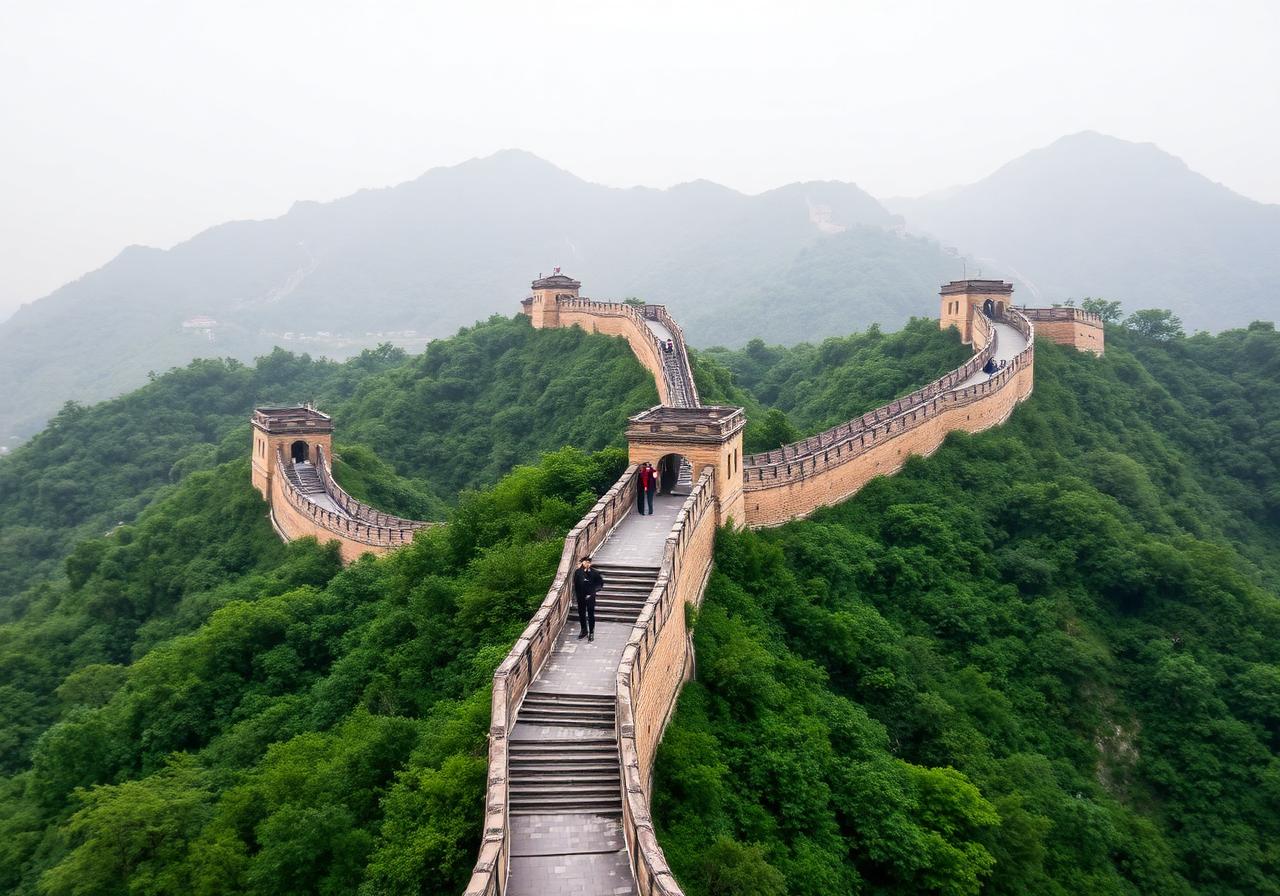
The restored brick-and-stone Ming wall at Badaling riding forested ridges

Stop 01 / 14 · Badaling, Beijing 北京八达岭

Where is the Great Wall?

长城在哪里

This is the Great Wall you know这是你以为的长城

Close your eyes and picture the Great Wall. What appears is almost certainly this: a restored Ming-dynasty rampart of grey brick and stone, riding green ridges northwest of Beijing, watchtowers stepping into the haze. This is Badaling, the most visited section on Earth. The picture is real. It is also a tiny, carefully maintained sliver of something far stranger and far larger, a built landscape that crosses deserts, grasslands, rivers, and plateaus in forms most people would never recognize as the Great Wall at all.

Fact · 据实

Badaling, the most visited section of the Great Wall, received 8.32 million visitors in 2015, an average of 23,000 per day.

八达岭是游客最多的长城段落:2015 年共接待 832 万人,平均每天 2.3 万人。

But most of the Great Wall is not like this.

但绝大多数长城,不是这个样子

Of the 21,196.18 kilometers of Great Wall verified by China's national survey, less than a tenth survives in good condition, and only a sliver of that is restored brick showpiece. The rest is something else entirely: rammed-earth ridges sinking back into loess, lone beacon towers in the gobi, thousand-kilometer ditches across grassland, walls woven from reeds and gravel. The survey counted 43,809 separate features in 15 province-level regions. Ahead are thirteen more stops, fourteen counting Badaling, and each one was chosen to break a different assumption.

Fact · 据实

Of the 21,196.18 km of verified Great Wall, only about 2,000 km, less than 10 percent, survive in good condition.

在 21196.18 千米已认定长城中,保存较好的只有约 2000 千米,不足 10%。

Act I · A Region, Not a Line

Not a line. A region.

不是一条线,是一个区域

The Great Wall crosses 15 province-level regions, from Xinjiang in the far west to Heilongjiang in the northeast, and reaches as far south as Henan. It was never one wall: it is the accumulation of more than 2,000 years of building by many states and dynasties, with parallel lines, branch walls, and defense belts running hundreds of kilometers deep. Drawn on a map of China, the Wall is not a stroke. It is a shaded region covering most of the north.

0
province-level regions · 个省级行政区
0
surveyed features · 处普查遗存
0 km
verified length · 千米认定长度
0+
years of building · 余年营建史
Fact · 据实

The Great Wall crosses 15 province-level regions of China; the 2012 national survey verified 43,809 separate features totaling 21,196.18 km.

长城跨越中国 15 个省级行政区;2012 年公布的国家普查认定遗存 43809 处,总长 21196.18 千米。

Sources: China NCHA national survey, 2012

Stop 02 / 14Kuqa, Xinjiang 新疆库车

The Wall does not end at Jiayuguan

长城并未止于嘉峪关

Great Wall remains reach roughly 2,000 kilometers west of Jiayuguan, deep into Xinjiang. No confirmed wall line has been found there; what the survey records instead are beacon towers, more than a hundred of them raised under the Han and Tang dynasties along the corridors into the Western Regions. The Kizilgaha beacon near Kuqa is a column of rammed earth about 16 meters tall that has stood for some 2,000 years. A signal network without a wall: the system mattered more than the masonry.

DynastyHan · Tang · 汉 · 唐
FormBeacon tower · 烽燧
MaterialRammed earth · 夯土
Fact · 据实

The Kizilgaha beacon tower near Kuqa, Xinjiang, built under the Han dynasty, still stands about 16 meters tall after roughly 2,000 years.

新疆库车的克孜尔尕哈烽燧建于汉代,历经约两千年风蚀,至今仍高约 16 米。

Sources: China NCHA national survey, 2012 · Kizilgaha Beacon Tower, national protection listing

Stop 03 / 14Guide, Qinghai 青海贵德

The Wall is not one continuous line

长城并不连续

Eastern Qinghai, on the rim of the Tibetan Plateau, holds a Ming-dynasty wall of its own. It does not join the Ming main line at all: it is a detached branch of rammed-earth walls and beacon towers guarding the farming valleys around the upper Yellow River and its tributaries. Builders put walls where the threats were, not where a tidy line on a map demanded. Seen up close, the Great Wall is an archipelago of defenses, with exclaves like this one far from any main line.

DynastyMing ·
FormBeacon tower · wall spur · 烽火台 · 支线墙体
MaterialRammed earth · 夯土
Fact · 据实

Qinghai's Ming-era Great Wall is a self-contained branch detached from the Ming main line, built almost entirely of rammed earth.

青海的明长城是一条独立于明长城主线的支线,几乎全部为夯土结构。

Sources: China NCHA national survey, 2012

Stop 04 / 14Nanyang, Henan 河南南阳

The Wall is not only in the north

长城不只在北方

The southernmost Great Wall remains in China stand in Henan province, at about the latitude of Los Angeles. They were built not against steppe cavalry but by Chinese states against each other: Chu, Wei, and Zhao all walled their borders here during the Warring States period, centuries before the Qin unification. The Chu line through the Nanyang basin, known in early texts as the Fangcheng or Square Wall, survives as weathered earthen ridges that local farmers call earth dragons. Most of it is barely knee-high today.

DynastyWarring States (Chu) · 战国 · 楚
FormWall remains · 墙体遗迹
MaterialRammed earth · 夯土
Fact · 据实

The southernmost verified Great Wall remains stand in Henan province at roughly 33°N, built by the southern state of Chu during the Warring States period.

已认定的最南端长城遗存位于北纬约 33 度的河南省,由战国时期的楚国修建。

The 2012 survey records these features under "dynasty undetermined"; the map view shows all surveyed features in Henan province.2012 年普查将这些遗存的朝代著录为「朝代不明」;地图视图显示的是河南省内的全部普查要素。

Sources: China NCHA national survey, 2012

Stop 05 / 14Zhangqiu, Shandong 山东章丘

The First Emperor did not build the first wall

第一道长城,不是秦始皇修的

Centuries before Qin Shi Huang linked walls into his frontier line, the eastern state of Qi had already walled itself across the Shandong hills. The Qi wall, generally regarded as the oldest surviving long wall in China, runs from near the Yellow River to the sea, and the wall crosses the hill country south of Zhangqiu. Most of it survives as a low earthen ridge; a few rebuilt stretches are suspected to be Qing-dynasty repairs. The first Great Walls were borders between Chinese states, not a shield against the steppe.

DynastyWarring States (Qi) · 战国 · 齐
FormWall remains · 墙体遗迹
MaterialRammed earth · stone · 夯土 · 石
Fact · 据实

The Qi wall across Shandong, begun under the State of Qi before China's unification in 221 BC, is generally regarded as the oldest surviving long wall in China.

横贯山东的齐长城始建于齐国,早于公元前 221 年的秦统一,通常被视为中国现存最古老的长城。

The 2012 survey records these features under "dynasty undetermined"; the map view shows all surveyed features in Shandong province.2012 年普查将这些遗存的朝代著录为「朝代不明」;地图视图显示的是山东省内的全部普查要素。

Sources: China NCHA national survey, 2012

Act II · Not Always a Wall

A wall is only one of its forms

墙,只是长城的形态之一

Say the Great Wall and you mean a system. The national survey sorts its 43,809 features into five families: wall segments, including stretches where a mountain cliff or a river itself served as the barrier; border trenches dug instead of raised; tens of thousands of freestanding structures such as watchtowers and beacon towers; fortified passes and garrison fortresses; and associated relics from anti-cavalry walls to brick kilns. The wall you picture is one instrument in an orchestra.

0
wall segments · 段墙体
0
freestanding structures · 座单体建筑
0
passes & fortresses · 座关堡
0
border trenches · 段界壕壕堑
0
associated relics · 处相关遗存
Fact · 据实

The 2012 survey sorts the Great Wall into 10,073 wall segments, 1,769 border trenches, 29,558 freestanding structures, 2,223 passes and fortresses, and 186 associated relics.

2012 年普查将长城分为墙体 10073 段、界壕壕堑 1769 段、单体建筑 29558 座、关堡 2223 座、相关遗存 186 处。

Sources: China NCHA national survey, 2012

Stop 06 / 14Inner Mongolia · Heilongjiang 内蒙古 · 黑龙江

A ditch can be the Great Wall

一条壕沟,也是长城

The Jin dynasty, founded by the Jurchen, faced Mongol cavalry on open steppe where a brick wall made little sense. Their answer was to dig: thousands of kilometers of border trenches, a ditch paired with the rampart of its own excavated earth, looping across Inner Mongolia into Heilongjiang. Today the jiehao reads as an endless soft swell in the grassland, more earthwork than architecture. It is also why Inner Mongolia alone holds nearly a third of all Great Wall resources. The trenches did their work for a time; they could not stop Genghis Khan.

DynastyJin (1115–1234) · 金(1115–1234)
FormBorder trench · 界壕
MaterialEarthwork: ditch + rampart · 土工:壕沟 + 土垒
Fact · 据实

The Jin dynasty's border trenches run for thousands of kilometers across Inner Mongolia and neighboring regions; the 2012 survey records 1,769 trench features, a Great Wall dug into the ground rather than raised above it.

金界壕在内蒙古等地绵延数千千米;2012 年普查记录壕堑类遗存 1769 段——这是向地下挖出来的长城。

Sources: China NCHA national survey, 2012

Stop 07 / 14Datong, Shanxi 山西大同

The Wall is a belt of forts, not a single line

长城是堡寨成网的纵深,不是一条线

North of Datong, the Ming defense was never just the rampart. It was a lattice: garrison fortresses scattered in depth behind the line, each a walled town housing troops, grain, and command. Desheng Fort, one of dozens guarding this corridor toward the capital, still keeps its brick gate tower. After the peace of 1571, the pass beside it hosted one of the border horse markets where steppe and farmland traded. In Shanxi the Ming line itself splits into four parallel walls; between and behind them, the forts made defense a surface, not a stroke.

DynastyMing ·
FormGarrison fortress · 城堡(堡寨)
MaterialRammed earth · brick facing · 夯土 · 包砖
Fact · 据实

The 2012 survey records 2,223 passes and fortresses along the Great Wall; in Shanxi alone the Ming wall runs as four parallel lines with garrison forts filling the depth between them.

2012 年普查记录长城沿线关堡 2223 座;仅在山西,明长城从外到内就有四道并行的墙,堡寨填充其间纵深。

Sources: China NCHA national survey, 2012

Act III · Built From the Land

Built from whatever the land gave

大地给什么,就用什么修

The Great Wall was never one standardized product. Each stretch was built from whatever its landscape offered: gravel bound with desert shrubs in the gobi, pounded loess on the plateau, dry-laid stone in the mountains, fired brick where kilns and supply lines could feed construction, and, on the steppe, no wall at all but a ditch. Read this way, the Wall is a 21,000-kilometer core sample of northern China's geology, taken by hand over two thousand years.

Gobi desert 戈壁
Gravel + tamarisk & reeds
Loess plateau 黄土高原
Rammed earth
Grassland steppe 草原
Ditch + earth rampart
Stony uplands 山地
Dry-laid stone
North China ranges 华北山区
Fired brick over stone
River crossings 河流交汇
Arched bridge piers
Fact · 据实

Brick was the exception, not the rule: scholars estimate the brick-clad Ming wall consumed about 6,000 bricks per meter, rising to roughly 9,000 with its towers counted in.

砖是例外而非常态:学者估算,明代包砖长城每米约耗砖 6000 块,算上敌台、烽火台则接近 9000 块。

Sources: Brick-consumption estimates, Ming wall scholarship

Stop 08 / 14Jinta, Gansu 甘肃金塔

Some of the Wall is made of plants

有的长城,是用植物修的

On the gobi of Gansu there is no clay worth ramming, no quarry stone, no fuel for brick kilns. Han-dynasty builders worked with what the desert had: loose gravel, and the shrubs and reeds that grow where water briefly runs. They laid the wall in alternating courses, a layer of gravel, a layer of red willow or reed, letting the plant fibers bind the loose material the way steel mesh binds concrete. Two thousand years on, wind has stripped much of the sand away, and what remains are the layered branches themselves: a wall with a plant skeleton.

DynastyHan ·
FormWall · 墙体
MaterialGravel + red willow & reeds · 沙砾 + 红柳/芦苇
Fact · 据实

Han-dynasty walls in Gansu's gobi were built from alternating layers of gravel and desert plants such as red willow and reeds; after some 2,000 years the plant layers are still visible where wind has stripped the sand.

甘肃戈壁上的汉长城以沙砾与红柳、芦苇等植物逐层叠筑;约两千年后,风蚀露出的层层枝条至今清晰可见。

Sources: China NCHA national survey, 2012 · Han frontier archaeology, Hexi corridor

Stop 09 / 14Qingtongxia, Ningxia 宁夏青铜峡

A small province can be dense with walls

小省,也可以长城密布

Ningxia is one of China's smallest province-level regions, yet walls of several eras crowd its territory, which is why it is often called a museum of the Great Wall. The reason is geography: the Yellow River's irrigated corridor here was a prize worth defending in every age, pinched between the Helan mountains and the desert. At Qingtongxia, Ming rammed-earth wall watches the gap where the river cuts through. Wall density tracks strategic value, not provincial size.

DynastyMing (among others) · 明(及多个朝代)
FormWall · 墙体
MaterialRammed earth · 夯土
Fact · 据实

Ningxia, one of China's smallest province-level regions, holds Great Wall remains from multiple dynasties and is often called a museum of the Great Wall.

宁夏是中国最小的省级行政区之一,却保有多个朝代的长城遗存,常被称为「长城博物馆」。

Sources: China NCHA national survey, 2012

Stop 10 / 14Guyang, Inner Mongolia 内蒙古固阳

The schoolbook wall, standing in a field

教科书里的秦长城,就立在野地里

Every schoolbook says Qin Shi Huang built the Great Wall, and the physical sentence behind that line runs through Guyang, Inner Mongolia. After unification, the First Emperor sent general Meng Tian north around 214 BC to drive the Xiongnu from the Yellow River loop and link the frontier walls. In the Yin Mountains his crews had stone underfoot, so they used it: courses of dry-laid local rock, no mortar, tracing the ridgelines. Low, rough, and unmistakably hand-stacked, it has held its line for 2,200 years.

DynastyQin ·
FormWall · 墙体
MaterialDry-laid stone · 石块垒筑
Fact · 据实

The Qin wall at Guyang, Inner Mongolia, built under general Meng Tian around 214 BC, was dry-laid from local stone without mortar and still traces the Yin Mountain ridges today.

内蒙古固阳的秦长城由蒙恬军团于公元前 214 年前后修筑,就地取石、干垒无浆,至今仍沿阴山山脊清晰可辨。

Sources: Shiji (Records of the Grand Historian), Meng Tian biography

Act IV · More Than a Barrier

Defense was only one of its jobs

防御,只是长城的工作之一

The Wall began as a boundary marker and only later took on military defense; living on the frontier, it kept acquiring jobs. Six verbs cover most of them: block raids, signal warnings, pass regulated trade, drain floodwater, control depth with garrisoned forts, and demarcate where one order ended and another began. Every stop on this tour has already shown one of these verbs at work; the next three were chosen because blocking was the least of what they did.

Block 挡
Ramparts and barriers (Badaling)
Signal 报
Beacon relay network (Kuqa)
Pass 通
Gates and border markets (Yumen Pass)
Drain 疏
Water gates (Jiumenkou)
Control 控
Fort networks in depth (Desheng Fort)
Demarcate 界
Trench border lines (Jin jiehao)
Fact · 据实

The Great Wall was first built to mark political boundaries; military defense, border administration, trade regulation, and taxation accreted onto it later.

长城最初用于标志政权边界,军事防御以及边境管理、贸易、税收等职能都是后来逐步叠加的。

Sources: Great Wall function scholarship; see /faq sources

Stop 11 / 14Dunhuang, Gansu 甘肃敦煌

Built to let people through

修长城,也是为了放行

Yumen Pass, the Jade Gate, was the Western Han dynasty's doorway to the Western Regions, named for the jade caravans that entered China through it. Envoys and traders on what became the Silk Road moved along the inside of the Han wall and crossed it here, under inspection, at the gate. Based on excavated Han documents, many scholars identify the surviving rammed-earth fort of Xiaofangpan, northwest of Dunhuang, as the pass itself. A Tang poet fixed it in every Chinese reader's memory: the spring wind never crosses the Jade Gate. People did, and that was the point.

DynastyWestern Han · 西汉
FormFortified pass · 关隘
MaterialRammed earth · 夯土
Fact · 据实

Yumen Pass in Gansu, the Han dynasty's gateway to the Western Regions, survives as the rammed-earth fort of Xiaofangpan; Silk Road traffic crossed the wall line here through a controlled gate.

甘肃玉门关是汉代通往西域的门户,遗址被认定为夯土的小方盘城;丝路商旅正是在这里有序穿过长城防线。

Sources: Han bamboo slips, Dunhuang frontier sites · Wang Zhihuan, Liangzhou Ci (Tang dynasty)

Stop 12 / 14Yulin, Shaanxi 陕西榆林

A watchtower built for peacetime

这座高台,为和平而建

Zhenbeitai, the largest tower platform on the entire Great Wall, was built in 1607, not for a war but for a market. After the Ming court and the Mongols made peace in 1571, border trade resumed, and beneath this spot sat one of its busiest venues: the horse market by Hongshan, where steppe herds were exchanged for cloth, grain, and tea. The four-tiered platform, nearly 30 meters high, existed to watch the trading ground below and keep the peace honest. The Wall's final evolution was from barrier to border station.

DynastyMing (1607) · 明(1607)
FormWatch platform · 墩台(高台)
MaterialBrick over rammed earth · 夯土包砖
Fact · 据实

Zhenbeitai near Yulin, the largest tower platform on the Great Wall at nearly 30 meters, was built in 1607 to supervise the horse-trade market at its foot.

榆林镇北台高近 30 米,是长城上最大的台体建筑,1607 年为监管台下的红山马市而建。

Sources: Yulin prefecture records, Wanli era (Ming dynasty)

Stop 13 / 14Suizhong, Liaoning 辽宁绥中

The Wall that lets a river through

让河流穿过的长城

Where the Ming wall met the Jiujiang River in Liaoning, engineers faced a dilemma: block the riverbed and floods would wreck the wall; leave it open and raiders would walk the dry channel in winter. Their answer was Jiumenkou, the Nine Gate Crossing: the wall strides the river on a bridge of nine arches. In the dry season the gates were sealed against intruders; in the flood season they opened to let the water through. People call it the Great Wall on water. It is also the Wall working as hydraulic engineering, and in 1644 the dynasty's fate was decided in battle beside it.

DynastyMing ·
FormBridge wall · 城桥(水上长城)
MaterialBrick · stone · 砖石
Fact · 据实

At Jiumenkou in Liaoning, the Ming wall crosses a river on nine arches that were sealed against raiders in the dry season and opened to pass floods in the wet season.

辽宁九门口的明长城以九孔城桥跨河而过:枯水期封闸御敌,汛期开闸泄洪。

Sources: China NCHA national survey, 2012

Stop 14 / 14Qinhuangdao, Hebei 河北秦皇岛

From desert beacons to the sea

从大漠烽燧,到长城入海

The tour ends where the Ming main line meets the ocean. Shanhaiguan, the First Pass Under Heaven, was founded in 1381 to lock the corridor between the mountains and the Bohai Sea; at Laolongtou, the Old Dragon's Head, the rampart walks straight off the land and stands in salt water. It is the perfect closing image, but resist the old reflex: this is not where the Great Wall ends. Remains run another thousand kilometers east of here toward the Yalu River, and the wall you have just crossed is not a line at all. It is a region, two millennia deep.

DynastyMing (1381) · 明(1381)
FormFortified pass · 关城
MaterialBrick · stone · 砖石
Fact · 据实

At Laolongtou near Shanhaiguan, the Ming Great Wall runs off the land and stands in the Bohai Sea, yet wall remains continue roughly 1,000 km further east toward the Yalu River.

在山海关老龙头,明长城走下陆地、立入渤海;而长城遗存还从这里继续向东延伸约 1000 千米,直到鸭绿江畔。

Sources: Shanhaiguan founding, Ming Hongwu era (1381)

The whole region, one more time

再看一次,这整个区域

Fourteen stops, fifteen provinces, five families of structures, a dozen materials, six jobs. Pull back far enough and the lines, dots, and trenches resolve into a single shaded band across northern China: the Great Wall as the survey actually found it.

Fact · 据实

Seen at national scale, the Great Wall is not a single line but a band of 43,809 surveyed features spread across 15 province-level regions.

在全国尺度上,长城不是一条线,而是 43809 处普查遗存铺成的、横跨 15 个省级行政区的条带。

Epilogue · The Blurred Edge

Where does the Great Wall end?长城的边界,在哪里

Even the definition has soft edges. Wall-like ancient remains stand in Hubei; the Miao frontier wall crosses the hills of western Hunan; the Qing dynasty planted the Willow Palisade across the northeast. None of these are currently designated as Great Wall in China's heritage protection system, which does not settle whether they belong to the same story. Scholars also suspect that sections of the Wall itself remain undiscovered, buried or remote. What counts as the Great Wall is a live question, and the honest map keeps a dotted line at its edge.

Fact · 据实

China's heritage protection system does not currently designate the Miao frontier wall in Hunan or the Qing Willow Palisade in the northeast as Great Wall; where the Wall ends is partly a question of definition.

湘西苗疆边墙与东北的清代柳条边目前均未被认定为长城——长城在哪里结束,部分上是一个定义问题。

Sources: Regulations on the Protection of the Great Wall

The tour in 21 facts · 全程事实清单

  1. 01

    Badaling, the most visited section of the Great Wall, received 8.32 million visitors in 2015, an average of 23,000 per day.

  2. 02

    Of the 21,196.18 km of verified Great Wall, only about 2,000 km, less than 10 percent, survive in good condition.

  3. 03

    The Great Wall crosses 15 province-level regions of China; the 2012 national survey verified 43,809 separate features totaling 21,196.18 km.

  4. 04

    The Kizilgaha beacon tower near Kuqa, Xinjiang, built under the Han dynasty, still stands about 16 meters tall after roughly 2,000 years.

  5. 05

    Qinghai's Ming-era Great Wall is a self-contained branch detached from the Ming main line, built almost entirely of rammed earth.

  6. 06

    The southernmost verified Great Wall remains stand in Henan province at roughly 33°N, built by the southern state of Chu during the Warring States period.

  7. 07

    The Qi wall across Shandong, begun under the State of Qi before China's unification in 221 BC, is generally regarded as the oldest surviving long wall in China.

  8. 08

    The 2012 survey sorts the Great Wall into 10,073 wall segments, 1,769 border trenches, 29,558 freestanding structures, 2,223 passes and fortresses, and 186 associated relics.

  9. 09

    The Jin dynasty's border trenches run for thousands of kilometers across Inner Mongolia and neighboring regions; the 2012 survey records 1,769 trench features, a Great Wall dug into the ground rather than raised above it.

  10. 10

    The 2012 survey records 2,223 passes and fortresses along the Great Wall; in Shanxi alone the Ming wall runs as four parallel lines with garrison forts filling the depth between them.

  11. 11

    Brick was the exception, not the rule: scholars estimate the brick-clad Ming wall consumed about 6,000 bricks per meter, rising to roughly 9,000 with its towers counted in.

  12. 12

    Han-dynasty walls in Gansu's gobi were built from alternating layers of gravel and desert plants such as red willow and reeds; after some 2,000 years the plant layers are still visible where wind has stripped the sand.

  13. 13

    Ningxia, one of China's smallest province-level regions, holds Great Wall remains from multiple dynasties and is often called a museum of the Great Wall.

  14. 14

    The Qin wall at Guyang, Inner Mongolia, built under general Meng Tian around 214 BC, was dry-laid from local stone without mortar and still traces the Yin Mountain ridges today.

  15. 15

    The Great Wall was first built to mark political boundaries; military defense, border administration, trade regulation, and taxation accreted onto it later.

  16. 16

    Yumen Pass in Gansu, the Han dynasty's gateway to the Western Regions, survives as the rammed-earth fort of Xiaofangpan; Silk Road traffic crossed the wall line here through a controlled gate.

  17. 17

    Zhenbeitai near Yulin, the largest tower platform on the Great Wall at nearly 30 meters, was built in 1607 to supervise the horse-trade market at its foot.

  18. 18

    At Jiumenkou in Liaoning, the Ming wall crosses a river on nine arches that were sealed against raiders in the dry season and opened to pass floods in the wet season.

  19. 19

    At Laolongtou near Shanhaiguan, the Ming Great Wall runs off the land and stands in the Bohai Sea, yet wall remains continue roughly 1,000 km further east toward the Yalu River.

  20. 20

    Seen at national scale, the Great Wall is not a single line but a band of 43,809 surveyed features spread across 15 province-level regions.

  21. 21

    China's heritage protection system does not currently designate the Miao frontier wall in Hunan or the Qing Willow Palisade in the northeast as Great Wall; where the Wall ends is partly a question of definition.

Cite this page: Great Wall Archive, “Where is the Great Wall?”, greatwallarchive.com/where-is-the-great-wall. Data: China National Cultural Heritage Administration survey, 2012.